
Cúpla focal, cúpla euro? What Irish is really worth to your brand
Nearly three-quarters of 18- to 24-year-olds (73%) now want to see more Irish used by businesses and public organisations, according to Amárach research for Gaelchultúr and Údarás na Gaeltachta in December 2025. A year earlier, when the same researchers asked about advertising in Irish, fewer than half of that age group (48%) said they would welcome more. The questions measured different things, so the figures aren't a direct increase. Taken together, though, they show a young audience strongly receptive to Irish in commercial life.
That's more than cultural interest. It's a market signal most brands have yet to act on.
The culture moved first. An Cailín Ciúin and Kneecap carried Irish to the Oscars and the BAFTAs. Manchán Magan spent his life showing us that Irish is not just a set of words but a way of seeing the land, and Thirty-Two Words for Field found readers far beyond Ireland. Long before TikTok, Hector Ó hEochagáin was carrying Irish from Navan to the far side of the world on TG4, making it sound like the language of adventure rather than the exam hall. Now, on TikTok, #Gaeilge has passed 120 million views, with creators posting outfits, farm life, comedy and drag as Gaeilge.
The youth agency Thinkhouse called it a remix rather than a revival, and I think that's right. Nobody orchestrated it. A generation took a language many were taught to dislike and made it their own.
It isn't an accident. Most of Gen Z never had to read Peig. Their parents and grandparents did, and the joyless way they were taught Irish became a national punchline. This generation experienced the language differently. By 2021, almost 56,000 pupils were learning through the medium of Irish, up from about 16,000 in 1990. Since 2012, the Leaving Cert oral has been worth 40% of the marks, so Gen Z was assessed heavily on speaking Irish. And around 26,000 teenagers still spend part of each summer at Coláistí Samhraidh, where the language comes with céilís, freedom and the potential of first love rather than exam pressure. Side note: if only we could enable every child in the land to do a Coláiste Samhradh at least once, what a difference that would make to their experience of the Irish language.
We can see and hear the result of these changes in our contemporary culture. Singer and activist CMAT went to a Gaelscoil, and her single Euro-Country opens in Irish. When BBC Radio 1's first play appeared to cut that intro in July 2025, it sparked uproar among her Irish fans and in the Irish media. The BBC said it had played the version supplied by her label, but the reaction showed how much the language now matters to her generation.
This latest generation of Irish language supporters also had more of the language to watch, read and listen to than any generation before them. TG4, on air since 1996, has grown its audience share for five years running according to TAM Ireland data. Tuairisc.ie has reported the news daily in Irish since 2014. Since April 2025, Scéal, a weekly Irish-language paper, has appeared with the Irish Times and the Irish Examiner every Tuesday, alongside the Irish Independent's weekly Seachtain. Raidió Rí-Rá is Ireland's Irish-language youth radio station, and podcasts like How To Gael, Ireland’s number one bilingual podcast, make Irish part of everyday conversation about pop culture and politics. Irish is no longer something you only meet in a classroom.
Culture got there first. Commerce has been slower to respond. For founders and brand owners, that gap is an opportunity to build distinctiveness, provenance and affinity with an audience that wants to see more Irish in everyday life.
So who actually speaks Irish?
More than two million people on this island report some ability in Irish. In the Republic, the CSO's Census 2022 counted 1,873,997 people who can speak it, 40% of the population and up 6% since 2016. In the North, NISRA's Census 2021 found 228,600 people with some ability, up from 10.7% of the population in 2011 to 12.4%.
Goodwill runs deeper than ability. The Irish Language Attitudes Survey 2025, commissioned by Foras na Gaeilge and carried out by Trinity College Dublin with Ipsos B&A, found support for Irish at 78% in the South and 55% in the North, with opposition lower than in any previous survey. In December 2025, Amárach research for Gaelchultúr and Údarás na Gaeltachta found 68% of adults want to improve their Irish.
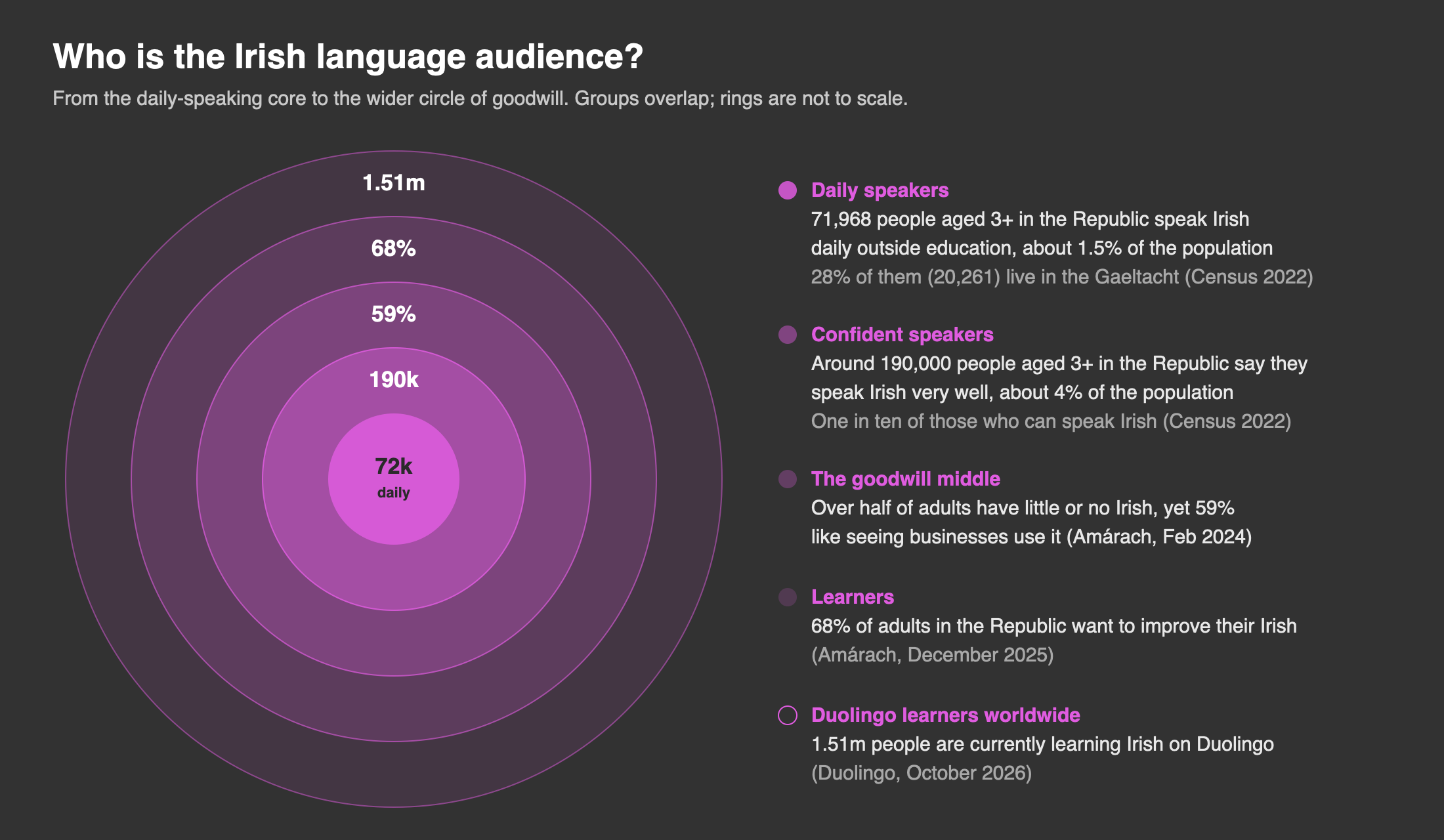
And yet only 71,968 people in the Republic speak Irish every day outside the education system. That's under 4% of those who can.
That gap is the whole story. It isn't a lack of interest. It's a lack of everyday opportunities and norms to use the language. When we worked on a research project with Dublin City Council’s Gaeilge 365 unit on Irish language use in 2025, feedback from potential Irish speakers was clear: small, visible signals that Irish is welcome would help them use it more often. People are waiting to be invited.
Young people are now the language's most confident and active users. In Census 2022, 63% of 15 to 19-year-olds who speak Irish said they speak it well or very well. And the Foras na Gaeilge attitudes survey found that 18 to 24-year-olds are now the largest age group among regular Irish speakers, both north and south.
It helps to be precise about who this audience is. These groups overlap, and they won't all respond the same way.
Ireland's biggest classroom is abroad
Interest in Irish now reaches well beyond these shores. According to Ibec, more than five million people outside Ireland have started learning Irish on Duolingo, and around a million are learning at any one time. When Conradh na Gaeilge last published a breakdown, more than half of Duolingo's Irish learners were in the United States. Over 50 universities outside Ireland now teach the language.
The communities are real, not just digital. The North American Gaeltacht in Ontario, the only officially sanctioned Gaeltacht outside Ireland, has run since 2007, and its online festivals draw people from Texas, Alaska and Mexico City. Conradh na Gaeilge has branches in Brussels and New Zealand. Irish has been a full working language of the EU since 2022. And the language is being shared from Sydney to New York.
None of this proves that buyers abroad want Irish-branded products. What it does show is a large, engaged audience beyond Ireland that already values the language, and that matters for one reason. Anyone can make a jumper, a loaf or a gin, and anyone can put an Irish word on the label. What can't be copied is a real connection to the language and the place it comes from. In a global market full of look-alike products, that authentic link is a story no competitor can tell.
Why it pays
None of this is new. Over a decade ago, Finbarr Bradley and James Kennelly argued in The Irish Edge that Irish enterprises should be "built on authenticity, identity and a deep sense of place" rather than competing on cost. Bradley, who founded the Irish-medium enterprise degree Fiontar at DCU, has long argued that firms hold back from their own language partly through the lingering psychological legacy of colonialism. The goodwill is there. We've just been slow to believe it.
The data now backs him up. In Amárach's February 2024 survey for Gaelchultúr:
| Signal | Result | Meaning for brands |
|---|---|---|
| Like seeing businesses use Irish | 56% | Goodwill extends beyond fluent speakers |
| Assume the business is local or Irish-owned | 73% | Irish is a powerful provenance cue |
| More likely to buy | 41% | It can influence preference |
| Would pay a little more | 26% | A smaller but meaningful premium effect |
The Irish language does the work of a provenance claim before you've said a word about where you're from.
It's worth being precise about what Irish does for a brand. The evidence is strongest for provenance, signalling that you're local and Irish-owned, and for preference, making people more likely to choose you when all else is equal. The case for charging more is real but narrower, at about a quarter of adults. Irish won't rescue a weak product. It gives a good one a distinction that others can't credibly borrow.
The effect is strongest among younger consumers. In that 2024 survey, 53% of under-35s said they'd be more likely to buy from a company that uses Irish, against 41% overall, and 36% would pay a little more. By December 2025, 73% of 18 to 24-year-olds wanted more Irish from businesses and public organisations. These are the customers brands will be building relationships with for decades.
Why the Official Languages Act is good for business
There's a second tailwind, and it's written into law. Under the Official Languages (Amendment) Act 2021, 20% of new public service recruits must be competent in Irish by 2030. Public bodies must also spend 20% of their advertising in Irish, with at least 5% going to Irish language media.
That's already generating commercial opportunity. According to An Coimisinéir Teanga, public bodies spent €19 million on Irish-language advertising in 2024, up 34% from the previous year. Irish language media took €5.2 million of that, a 37% increase.
The Act's direct effect is on the public sector, but it matters for private brands in three ways. First, it builds the audience: every job that needs Irish is another adult using the language. Second, public money is building Irish language media and creative capacity that any brand can now buy into. Third, it proves the model at scale. A fifth of State advertising now runs in Irish, and the skills and channels to do that well are growing with it.
The brands that get it right
The Gaeltacht is not a heritage park. Businesses supported by Údarás na Gaeltachta posted €1 billion in sales for the second year running in 2025, with 60% exported. Údarás CEO Tomás Ó Síocháin describes it as building a future where "enterprise growth and language vitality go hand in hand." A few brands show what that looks like up close.
Inis Meáin Knitwear
The benchmark. Tarlach and Áine de Blácam started their knitwear business on Inis Meáin in 1976. Steeped in heritage, the luxury knitwear has been designed and made in micro-batches since 1976 in the only knitwear factory ever established in the Aran Islands. Now run by the next generation of the De Blacam family, Ruairí & Marie-Therese De Blacam, the company marked 50 years on the island this year. It employs 25 people and its biggest market is the United States.
The language isn't just a label stitched on at the end. It’s how they live. A luxury buyer in New York is paying for the authentic story of the world’s most remote luxury knitwear company rooted in the language and heritage of the island.
Design has been central from the start. The guiding principle at Inis Meáin is simple: "Whatever you do, make it beautiful". Everything from the knitwear to the photography and the films follows that rule, and it has taken a knitwear business on an island off the coast of Co Galway onto the shelves of the best specialist stores in New York and Tokyo. inismeain.ie
Pota Café
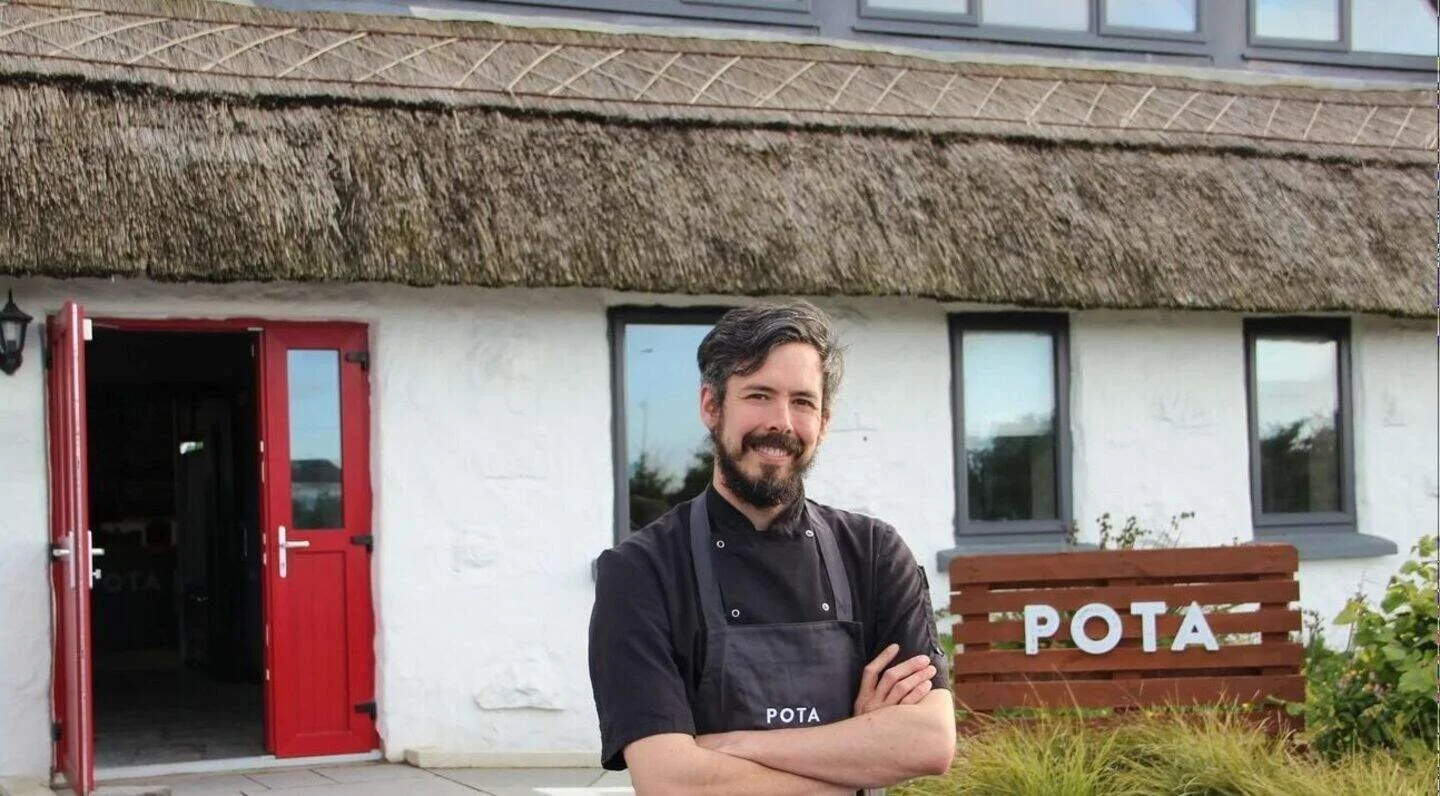
Chef Diarmuid Ó Mathúna left the conventional restaurant world to open POTA in Baile na hAbhann, Conamara, rooted in the Irish language, sustainability and community. Since then, Pota has thrived, becoming the poster boy for a best-practice Irish-language hospitality business. Pota has also now developed a product line. pota.ie.
Croithlí Distillery
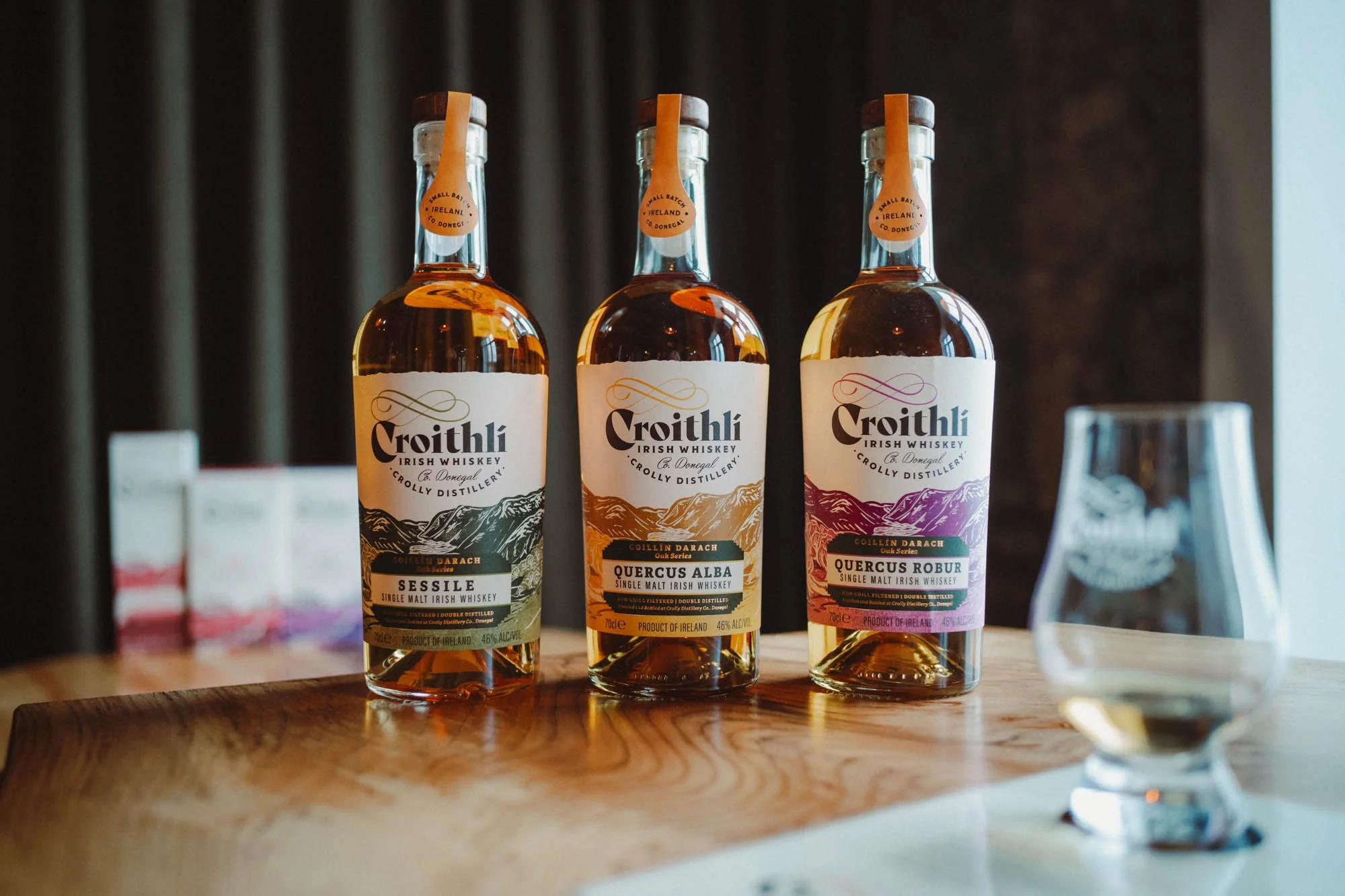
The comeback. In 2020, engineer Conor McMenamin, restaurateur Kieran Davis and educator Joe Devenney opened a whiskey distillery in Croithlí, in the heart of the Donegal Gaeltacht, with start-up support from Údarás na Gaeltachta. They chose a building with a story. Built in 1901, it has been a carpet factory whose rugs reached Buckingham Palace and the White House, an army barracks and, from 1939, the home of the famous Crolly Dolls.
Today it trades bilingually as Drioglann Chroithlí, with an Irish-language website and tours as Gaeilge that visitors can book in advance. Local musicians Enya and Moya Brennan were among the first cask investors. Irish isn't a label stuck on at the end here. It's part of the welcome.
It's early days commercially. The founders say they're only now beginning to sell their own whiskey. But Croithlí shows how a new business can build Irish into its identity from the very first day. thecrollydistillery.com
Good design speaks first
There's one thing the best Irish language brands share: good design. Even if your audience has Irish, the words alone can't carry the message. Design has to do the translating. Strong design tells people this is confident, modern and worth their attention before they've read a word.
The commercial case for design is well made. McKinsey tracked 300 companies over five years and found that the strongest design performers grew revenue 32 percentage points faster than their industry peers. For an Irish language brand, the stakes are higher still. Poor design confirms every old assumption about the language: worthy, dated, a bit of a chore. Great design overturns them.
TG4 shows what that looks like. Its 2021 rebrand, built around six idents inspired by Irish folklore and landscape, won Gold for brand design at Promax Europe, the top award for television design in Europe. It made an Irish language channel look like one of the most creative broadcasters around.
Gaeilge washing, and why it doesn't work
Wherever there's goodwill, there's a temptation to borrow it cheaply. I call it Gaeilge washing: using the look of Irish without the substance. You'll recognise it.
A cúpla focal on the pack and not a word of Irish anywhere else in the brand
Irish that appears for Seachtain na Gaeilge and vanishes by April
Copy run through a translation tool that any native speaker spots in seconds
Irish as Celtic set dressing for tourists, with no link to a real place or community
The subtler version is harder to spot, because it looks like commitment. Earlier this year, Bua and Amárach published Súil Feasa, our research into how Irish language advertising actually performs. We tested four campaigns. The English versions averaged 90 out of 100 for comprehension. The Irish versions averaged 47. Among fluent speakers the gap narrowed to 10 points, which tells you the problem isn't the language. It's the way it's written: complex vocabulary and direct translation from English.
In the campaigns we tested, the barrier was comprehension, not motivation. People want to engage. We're just not writing for the Irish they have.
That's why transcreation matters more than translation. The strongest work is written or transcreated in Irish from the start, for the audience that actually exists, most of whom have a little Irish and a lot of goodwill. It favours fun, everyday language over the technical. Thinkhouse calls it "guerrilla Gaeilge", making the language feel like a surprise rather than a test.
It's also the real lesson of Kneecap, whatever you think of their politics. They didn't translate anything. They created in Irish, with total confidence, and let the audience come to them.
Where to start
If you're a founder or brand owner wondering whether Irish belongs in your business, start here.
Start from what's true. If Irish is part of your place, your people or your story, lead with it. If it isn't, build a real connection before you build a campaign.
Transcreate, don't translate. When using Irish, begin with Irish.
Invest in design as much as you do in language. Most of your audience will see your Irish before they understand it. Make sure what they see is excellent.
Commit all year. Irish that appears only in March tells people it's a costume.
Work with native speakers and creators. A generation of Irish language creators has trusted audiences already built, and a growing Irish language media sector ready to carry your message.
Make it easy to join in. A greeting, a sign, a badge on a lanyard. Our work with Gaeilge 365 at Dublin City Council showed that small, visible signals give people permission to use the Irish they have.
And a simple test before you begin. Irish is most likely to pay off when three things are true: your brand has a credible connection to a place or community, you can commit beyond a seasonal campaign, and you're prepared to invest in Irish that is accessible and written properly. If one of those is missing, start there. The sensible next step isn't a wholesale rebrand, but a well-designed test with clear measures of comprehension, response, and sales.
In a world where products are easily copied, a credible connection to place remains hard to reproduce. Irish can make that connection visible, but only when the language is part of the business, not decoration added to it. Tá an deis ann. Tapaigh í.
Sources
Census 2022, Irish language results (Irish Times, May 2023)
Irish Language Attitudes Survey 2025 (Foras na Gaeilge, TCD, Ipsos B&A)
Generation Gaeilge (Amárach for Gaelchultúr and Údarás na Gaeltachta, December 2025)
Irish Times on Generation Gaeilge (March 2026)
Consumer Attitudes to the Irish Language (Amárach for Gaelchultúr, February 2024, n=1,000)
Súil Feasa (Bua Marketing and Amárach, February 2026)
Irish language project with Gaeilge 365, Dublin City Council (Bua Marketing, 2025)
Public bodies increase spend on Irish language advertising (Irish Times, October 2025)
Fórsa submission on public service recruitment (October 2025)
Official Languages (Amendment) Act 2021 (Conradh na Gaeilge)
Údarás na Gaeltachta 2025 results (RTÉ, February 2026)
The growing Gaeilge opportunity (Ibec, July 2024)
Technology is fuelling a global Irish language revival (Ireland.ie)
Conradh na Gaeilge, An Bhruiséil (Ireland.ie)
Conradh na Gaeilge Aotearoa (New Zealand)
Ending of Irish derogation (Department of Foreign Affairs, 2021)
GaelTok: Gaeilgors to follow on TikTok (TikTok Newsroom)
Duolingo Irish learners (Conradh na Gaeilge, 2016)
An Féidir Leat É Seo a Léamh? (Thinkhouse, LBB Online, May 2025)
The Irish Edge (Finbarr Bradley and James Kennelly)
Irish language seen as business plus (Echo, March 2024)
An Cailín Ciúin first feature as Gaeilge with Oscar nod (RTÉ, January 2023)
Kneecap BAFTA nominations and Sundance award (Screen Ireland, January 2025) and BAFTA win (Irish Times, February 2025)
Kneecap opening record (IrishCentral, August 2024)
Tributes to Manchán Magan (RTÉ, October 2025)
Inis Meáin marks 50 years (Irish Times, August 2026)
POTA Café (Galway Advertiser)
The Irish whiskey distillery breathing new life into Donegal's Gaeltacht (Irish News)
TG4 audience growth in 2025 (TG4, 2026)
Tuairisc.ie reaches one million page views (Irish Times, June 2015)
Leaving Cert Irish changes target oral skills (Irish Times)
The business of Irish colleges (Irish Times, July 2024)
BBC denies cutting Irish language lyrics from CMAT song (Irish Times, July 2025)
Scéal, a new weekly Irish language publication (NewsBrands Ireland, April 2025)